
PVD Gold vs Gold Plated: Is It Real Gold?
What PVD is, how it differs from plating, filled and solid gold, and what our chains are made of.
- Wear it every day in the shower, at the gym and to bed. The stainless steel resists rust, and the finish wears from friction, not from water.
- Wears slower than plating because the gold color sits on titanium nitride, a ceramic many times harder than gold. It takes the rubbing that wears ordinary plating through.
- Priced to wear, not to melt it is stainless steel under a 14K gold finish, not solid gold, which is why it costs a fraction of one.
- 3 to 5 years of daily wear is what Josef, our co-founder, expects. The first wear shows on the inside of the links, as a slightly darker gold. The guarantee covers the finish.
What PVD gold is
Physical vapor deposition (PVD) turns the coating material into a vapor inside a vacuum chamber and lets it settle on the jewelry atom by atom. The stainless steel is cleaned with charged particles first, so the coating grips the surface firmly.
A gold PVD finish can be one layer or two. Some are only a hard ceramic in a gold color, most often titanium nitride or zirconium nitride, the coatings used on cutting tools and watch cases. Others add a thin layer of real gold on top, which sets the exact color. Ours has both: the ceramic takes the wear, the gold carries the color.
| Layer on our chain | What it does for you |
|---|---|
| 14K gold, on top | The color you see. |
| Titanium nitride, under it | Takes the rubbing. It is why the color lasts. |
| Stainless steel links | The strength and the water resistance. It is why you can shower in it. |
What gold plating is
Traditional gold plating is electroplating. The piece is dipped in a bath of dissolved gold and an electric current lays the gold onto it. It is a fast, inexpensive way to color brass, copper or silver jewelry gold. Under the gold there is usually a thin layer of nickel or palladium, silver in color, but no hard ceramic. When the gold wears through at a rubbing point, the layers under it show.
Which finish for which wearer
Every gold finish is a trade between how much gold you pay for and how you want to wear it. This is how they compare for a chain you put on and leave on.
| Finish | Suits | Shower and gym | What is underneath | Where it wears first |
|---|---|---|---|---|
| Solid gold | A piece kept for decades, or bought for its gold | Yes | Gold all the way through | Scratches show; the color never changes |
| Gold filled | Daily wear, kept out of water | Better off | A base metal under a bonded layer of 10K or better gold, at least 1/20 of the weight | Slowly, at edges and the clasp |
| Vermeil | Occasional wear | Take it off | Sterling silver under at least 2.5 microns of gold | Rubbing points, then the silver tarnishes |
| Gold plated | A look you wear now and then | Take it off | Brass, copper or silver, usually with nickel or palladium under the gold | Rubbing points, where the metal under it shows |
| PVD gold over stainless steel (ours) | Worn every day, without taking it off | Yes; rinse after the pool or sea | Stainless steel under titanium nitride, then gold | Inside the links, as a slightly darker gold |
Gold filled and vermeil are defined by the US Federal Trade Commission in its Jewelry Guides (16 CFR 23.3 and 23.4). The real difference between the plated finishes is not the gold on top; it is what is under it and how hard that layer is.
Why the layer under the gold matters
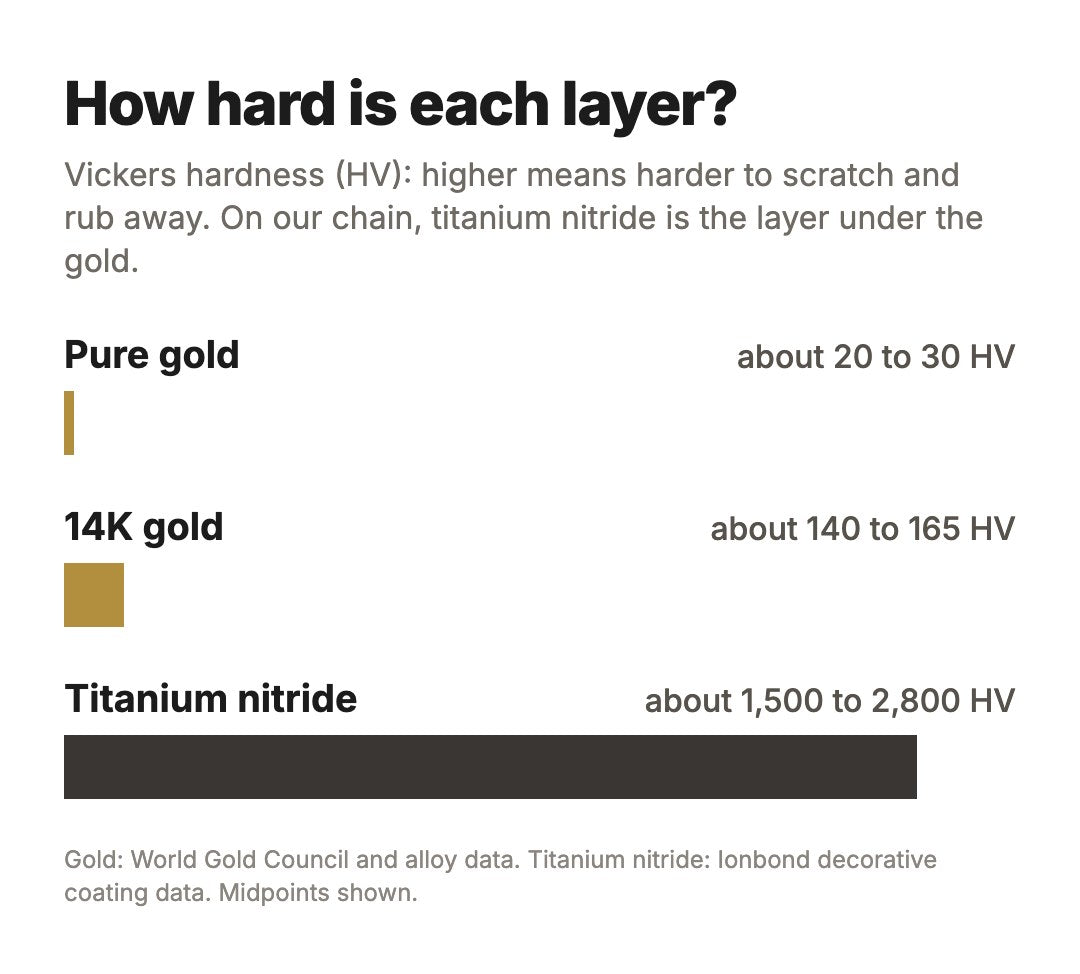
Gold is one of the softest metals there is, which is why electroplated gold rubs off at the points that touch your skin and each other. Under the gold on our chain is titanium nitride, many times harder than 14K gold. The color lasts longer, and when the very top wears, what shows first is the gold colored ceramic, not gray stainless steel. It is a little darker than the gold, so you may notice it where the links rub.
Is a PVD gold chain real gold?
The color is real gold; the chain is not solid gold. On our Classic, the top layer is 14K gold over a titanium nitride layer, on solid stainless steel links. That is the honest description, and it is the reason for the price: a solid gold Cuban link of the same size is a different purchase entirely.
What you get for that: a chain you can wear in the shower, to the gym and to bed, because stainless steel resists rust and the finish grips it firmly.
What does 18K or 14K PVD gold mean?
When a seller says 14K or 18K PVD, it can mean the gold alloy in the top layer or only a shade of color; no standard settles which. 14K reads a little lighter and warmer; 18K a little deeper yellow. Our Classic is 14K.
Will a magnet stick to it?
Gold is not magnetic. Stainless steel used in jewelry is only weakly magnetic or not at all, so a magnet tells you little about a stainless steel chain either way.
Can you sell or pawn a PVD gold chain for its gold?
No. A buyer of scrap gold pays by the weight of the gold, and a PVD chain is bought to be worn, not melted. Its value is the years you wear it.
How long PVD gold lasts
Josef, our co-founder, expects three to five years of daily wear, with wear showing first between the links where they rub. Scraping against hard surfaces wears it fastest. We have not lab tested that number, and no standard puts years on a PVD finish, which is why the guarantee has no time limit.
Every dollar back, and you keep the chain. If the finish ever stops looking right to you, write to us and we refund you in full or send a new one. No time limit.
The chains in this guide
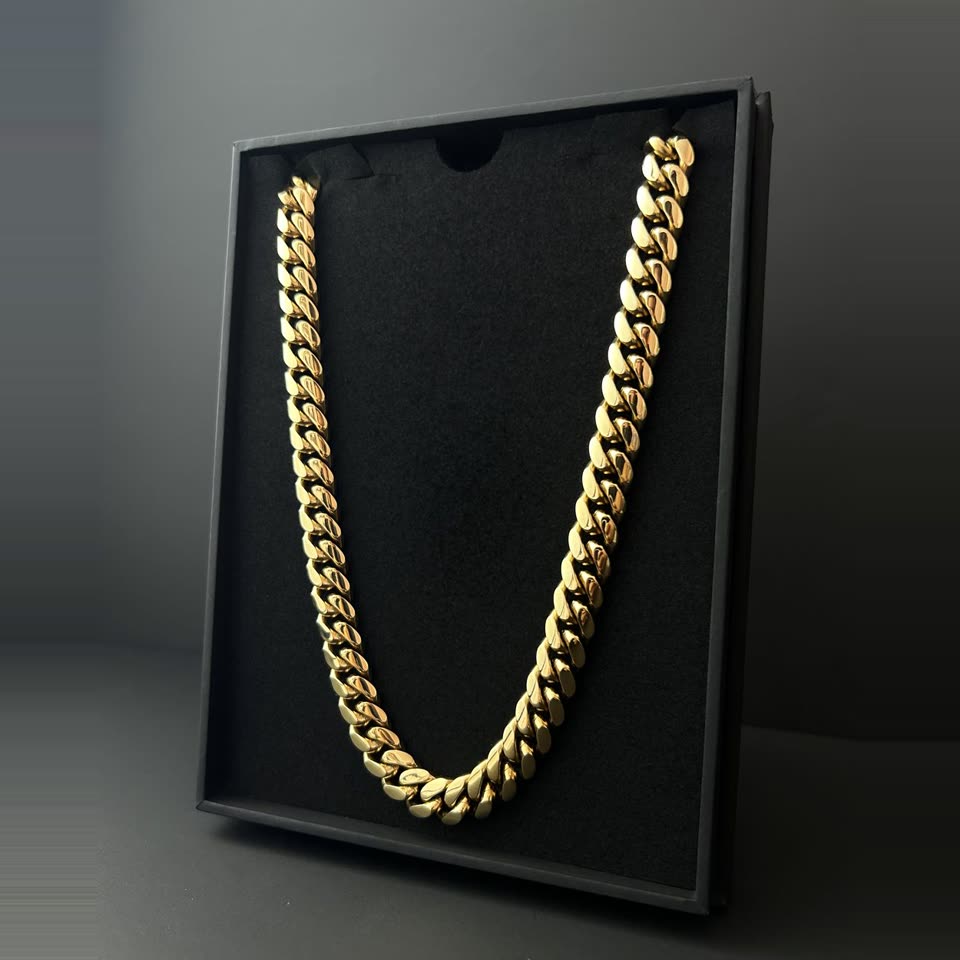
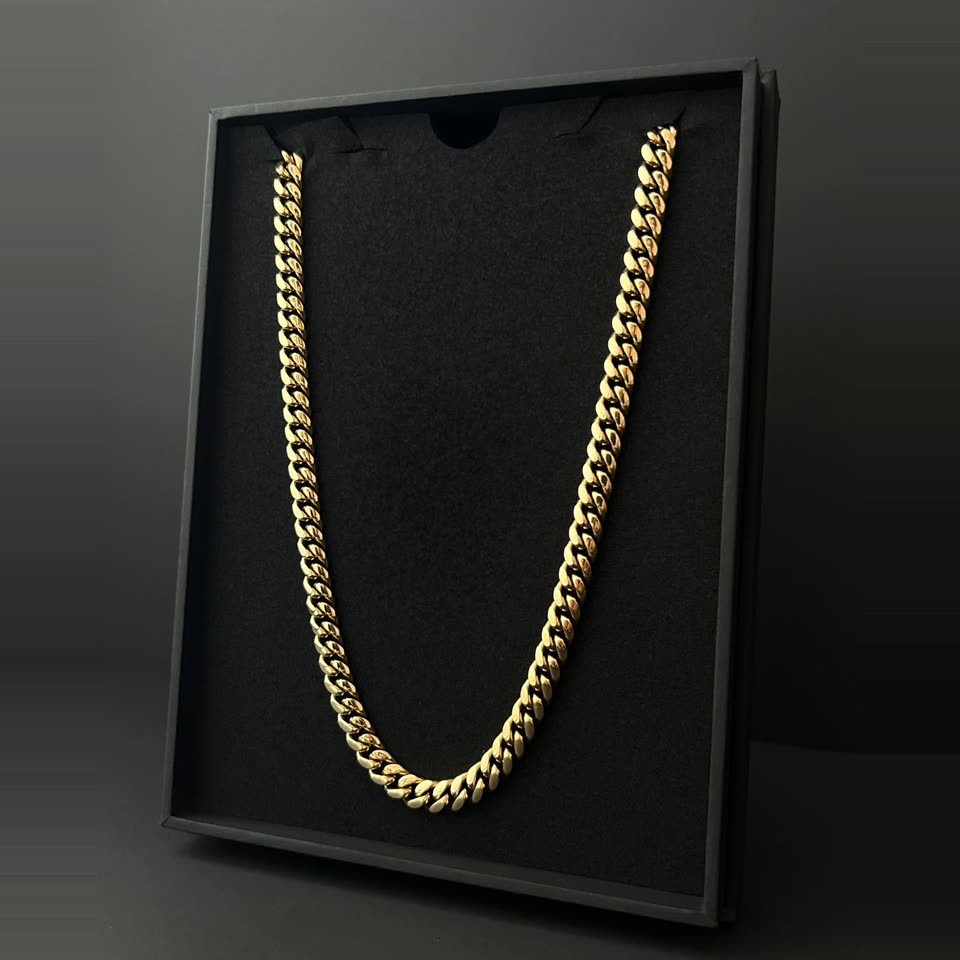
The Classic Cuban link, 14K gold over solid stainless steel, in 8mm or 12mm. For widths and lengths, see the size chart and what length to wear.
Sources: US Federal Trade Commission, Guides for the Jewelry, Precious Metals, and Pewter Industries (16 CFR Part 23); Martinuzzi, Giurlani et al., PVD for Decorative Applications: A Review, Materials, 2023; C. W. Corti, World Gold Council, Metallurgy of Microalloyed 24 Carat Golds (hardness of gold), 1999; Ionbond, decorative PVD coating data (titanium nitride hardness, coating materials); our finish from the factory specification; wear from Josef, our co-founder.